Dead Reckoning at the Food Court: A Requiem for the Fiberglass Galleon
Somewhere in America right now — probably somewhere off an interstate exit with a name like "Pointe" or "Commons" — a fiberglass galleon is hanging in the dark above a shuttered Cinnabon. Its sails are gray with dust. One cannon points at a boarded-up Sunglass Hut. The animatronic parrot has been dead since the Bush administration, and honestly, it died doing what it loved: screeching at a nine-year-old.
I think about that ship more than is healthy. So let's pour one out of a plastic Orange Julius cup and talk about the strange, wonderful, extinct species known as the indoor mall pirate ship.
A Short, Glorious Reign on a Landlocked Sea
The indoor galleon was a product of the great American mall arms race of the 1980s and '90s, when developers decided that a food court alone was not enough — it needed narrative. The Mills-style megamalls of that era went full theme park, carving their interiors into "neighborhoods" with fake lighthouses, fake caves, fake rainforests, and, yes, fake pirate ships. If you were building a 1.4-million-square-foot temple to consumerism, why not hang a 40-foot schooner from the ceiling? What could it possibly cost?
(Answer: a lot. A recurring theme in this story.)
These ships were never meant to be historically accurate. They were meant to be legible from fifty yards away, ideally while a toddler screamed for a pretzel. The design brief was essentially: make it a pirate ship, but make it also a staircase.
Anatomy of a Landlocked Sea Monster
If you ever stood beneath one, you remember the checklist:
- The cannons. Plywood or fiberglass tubes, painted black, permanently aimed at nothing. Occasionally they'd belch fog from a machine that smelled like a hot swimming pool.
- The sails. Usually furled, always somehow sagging, like the ship had given up mid-voyage somewhere around Auntie Anne's.
- The crow's nest. A crow's nest you were absolutely not allowed to climb, which is why a generation of children spent their entire mall childhoods plotting to climb it.
- The treasure chest. Sometimes part of the ride, sometimes a photo-op, always overflowing with gold-painted plastic coins that had been chewed by other people's children.
- The parrot. Animatronic. Lime green. Vocabulary of roughly three phrases, one of which was a cough.
And then, in the corner, usually: a coin-operated ride shaped like a boat, bolted to the floor, rocking gently for one quarter at a time. A ship within a ship. Very meta. Nobody thought about it at the time.
How the Ships Went Down
Retail apocalypse is the obvious headline, but it's not the whole obituary. Mall traffic fell, anchor tenants folded, and suddenly every square foot of fantasy had to justify itself against a spreadsheet. A pirate ship doesn't generate rent. It generates ambience, which is a hard thing to put in a quarterly report.
There were practical problems too. Fiberglass doesn't love humidity. Fog machines need maintenance. Suspended structures need inspections, and inspectors are famously unromantic people. And the liability question — a decorative galleon with a climbable rigging area is, from an insurer's perspective, less a ship and more a lawsuit with sails.
So the pattern went like this, mall by mall: the fog stopped. The parrot broke. Someone hung a banner over the hull for a holiday sale. Then a tarp. Then the store beneath it closed, and the ship became a very expensive ceiling fixture over a very empty room.
Field Notes From the Wreck Site
If you visit a dead or dying mall today — and you should, gently, like a tourist in Pompeii — here's what the pirate archaeology looks like.
The ship is usually still there. That's the thing nobody tells you. These structures were so expensive and so bolted-in that demolition crews simply skipped them. You'll find the hull intact above a dark concourse, the portholes glowing faintly with reflected emergency-exit light. Sometimes the treasure chest survives as a planter. Sometimes the animatronic parrot is still mounted, silent, watching a man in a windbreaker eat a soft pretzel alone at 11 a.m.
Look for the ghosts of signage: a worn decal reading "PIRATE'S COVE" in a font that screams 1994, or a directional sign with an arrow pointing to a store that stopped existing two recessions ago. Look for the scuff marks on the railing where forty thousand kids leaned over to see the fake water.
It's eerie. It's also weirdly moving. Somebody designed this thing to make a Tuesday afternoon feel like an event, and for a while, it worked.
What the Wreckage Is Trying to Tell Us
Here's my theory, offered at the same confidence level as a guy with a metal detector on a beach: the indoor pirate ship was the last gasp of free ambient weirdness in American commercial space. It cost nothing to look at. It required no ticket, no reservation, no app. You could stand underneath it and feel a small thrill of narrative in a place otherwise devoted to selling you sneakers.
Today's version of that thrill is a themed experience you book in advance for $39 a head, with a QR code and a waiver. Which is fine. But there's something lost when wonder gets ticketed.
How to Mourn Properly
Go to a mall that's on its way out. Buy something small from a survivor — a candle, a phone case, a corn dog. Stand in the food court and look up. If there's no ship, look for the mounting brackets. They're usually still bolted to the ceiling beams, four sad little steel footprints marking where a galleon used to fly.
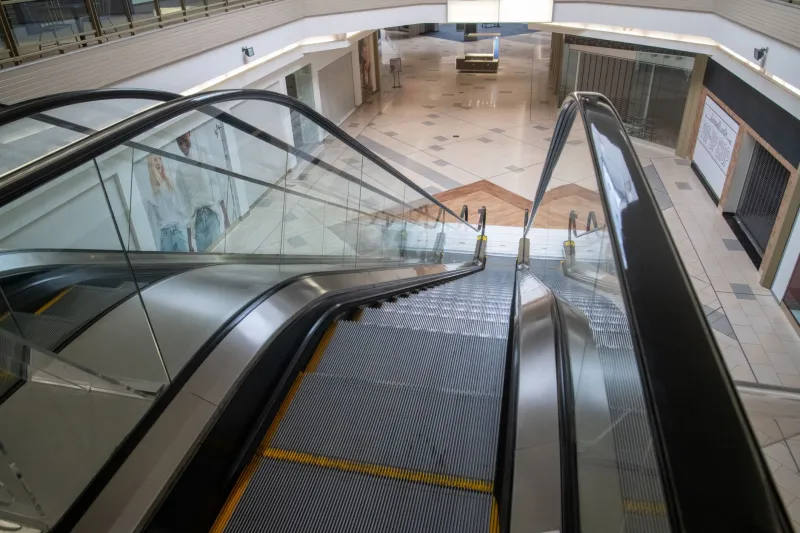
Say something nautical. Nothing fancy. "Fair winds" works. Then throw a penny in the wishing well, if the well's still there, and head for the exit past the dead escalator.
All malls are ships, really. They just don't know it yet.