Mutiny in Suite 4B: Why America Can't Stop Locking Itself in Pirate Escape Rooms
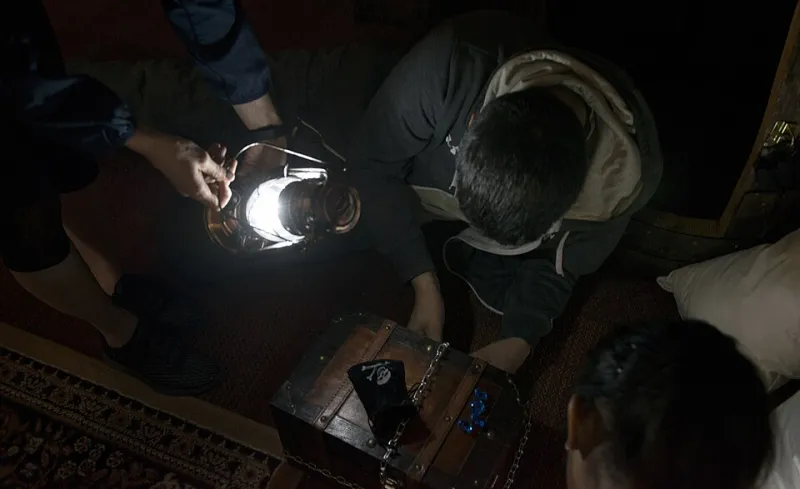
Photo: Airman 1st Class Tryphena Mayhugh, Public domain, via Wikimedia Commons
There is a specific smell to a pirate escape room. It is part musty carpet, part fog machine, part the collective sweat of six strangers who have been arguing about a padlock for eleven minutes. I know this smell intimately now, because I have paid money — real, grown-up money — to be locked inside a plywood galleon in a strip mall next to a mattress store that was having a going-out-of-business sale that has apparently been going on since 2019.
Welcome aboard. Please leave your dignity with the front desk.
The Galleon Next to the Mattress Store
Pirate escape rooms are everywhere now. Not just in tourist towns with actual harbors, either. I'm talking about Ohio. I'm talking about a converted nail salon in a Texas suburb where the "ocean" is a painted tarp and the "cursed treasure" is a plastic chest from Party City with a Bluetooth speaker taped inside it. According to the internet (and my own deeply unscientific survey of Yelp reviews), you can now find pirate-themed escape rooms in nearly every state, ranging from charmingly homemade to alarmingly high-tech.
The high-end ones are genuinely impressive. Think motion sensors, animatronic parrots that squawk clues in a suspiciously human voice, and treasure vaults that open with a satisfying ka-chunk when your crew finally solves the riddle. The low-end ones are... also charming, in the way that a haunted house run by teenagers is charming. One room I visited had a hand-drawn map taped to the wall with a note that said "DO NOT TEAR" in Sharpie. Reader, we tore it.
Why the boom? Partly because escape rooms in general have become the default activity for birthday parties, bachelorette weekends, and corporate team-building events where HR wants everyone to "bond" but not so much that anyone mentions the layoffs. But pirate rooms specifically have something the others don't: a ready-made story engine.
Why Piracy Is the Perfect Escape-Room Engine
Here's the thing about escape rooms: they need a reason for you to be trapped, and they need a reason for you to solve puzzles instead of just jiggling the door handle until someone gives up. Zombie rooms have to explain the outbreak. Prison rooms have to explain the wrongful conviction. Pirate rooms get to skip all of that. You are, by definition, on a ship. Ships are already a trap. The ocean is right there.
And the pirate fantasy comes pre-loaded with puzzle mechanics. A treasure map is basically a puzzle already. A mutiny is a social deduction game. A cursed idol is a prop you can hide a magnet in. The lore does the heavy lifting, which means the room designer gets to spend their budget on fog machines and a captain's wheel that may or may not be structurally load-bearing.
There's also the group dynamic. Escape rooms are best when everyone has a role, and pirate crews come with roles built in. Someone gets to be the captain and shout orders. Someone gets to be the navigator and squint at a map. Someone gets to be the powder monkey, which in practice means crawling under a table to look for a key. And someone — there is always someone — gets to be the mutineer who insists the answer is "probably 1776" for reasons no one can explain.
What These Rooms Get Wrong (Everything, Gloriously)
Now, I am not a historian. I am a blogger with a keyboard and a grudge. But I have read enough to know that pirate escape rooms are to actual 18th-century seafaring what a corn dog is to fine dining. Let's review the damage.
The padlocks. So many padlocks. Actual pirates of the Golden Age did not secure their treasure with combination locks from the hardware aisle. Most sailors couldn't read, let alone memorize a four-digit code. If a pirate wanted to keep something safe, he buried it, hid it, or — and this is the historical term — drank it.
The treasure maps. The iconic X-marks-the-spot map is largely a fiction, popularized by Treasure Island in the 1880s, a solid century after the so-called golden age of piracy. Real pirates didn't sketch maps on parchment. They didn't have parchment. They had rum and bad decisions.
The parrots. Parrots were real, but they weren't pets. They were cargo. A pirate with a parrot on his shoulder was less "swashbuckling rogue" and more "guy who is about to sell you a bird at a markup." The shoulder-perching thing is a later invention, probably by someone who had never been within fifty feet of a parrot and did not know how much they bite.
The plank. Walking the plank is almost entirely a theatrical invention. Pirates who wanted to dispose of someone simply threw them over the side, which is faster, cheaper, and requires no carpentry. The plank is a great visual, though, so escape rooms love it. One room I visited had a plank that was clearly just a skateboard painted brown.
The rum. Okay, the rum is accurate. Carry on.
The Cursed Treasure of Groupon
What strikes me most about the pirate escape room boom is how thoroughly it has colonized the American strip mall. The same retail spaces that once held Blockbuster and RadioShack are now holding cursed galleons. It is a strange kind of recycling — the internet killed the video store, and the video store's corpse got a second life as a place where you pay $35 a person to pretend you're on a boat.
And honestly? It rules. There is something deeply satisfying about watching a group of adults in business casual argue about whether a compass rose on a canvas map is pointing to the number 4 or the letter A. There is something even more satisfying about the moment the door finally clicks open and everyone stumbles into the fluorescent light of the lobby, squinting like they've just been rescued from an actual shipwreck.
The rooms get the history wrong. They get the accents wrong. They get the nautical terminology so wrong that a real sailor would weep into his grog. But they get the feeling right — the sense of being trapped with your friends, a bad map, and a ticking clock, which is basically what being on a pirate ship was like anyway, minus the scurvy and the weevils.
So lock me up, Captain. I'll take the plywood galleon over the mattress store any day. Just please, for the love of all that is holy, stop making the final clue a riddle about longitude. Nobody in that room knows what longitude is. Nobody ever has.
And if you're the person who insists on shouting "arrr" every time you find a key — you know who you are — the mutiny was justified.