Aged in New Jersey: The Secret Life of America's Ubiquitous Treasure Map
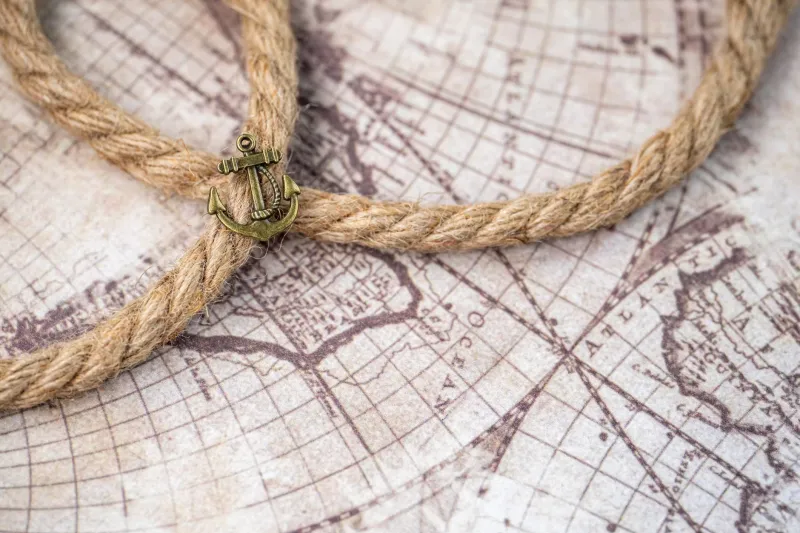
Last month, in a cavernous antique mall just outside Philadelphia, I counted the same treasure map four times. Same island. Same dotted line. Same jaunty little galleon. Same price tag, more or less: $18.95 in booth 112, $14 in booth 47, and a suspiciously crisp $22 version near the register. By the fourth sighting I felt less like a shopper and more like a character in a heist movie who has just realized the painting is a forgery.
This is not a Philadelphia problem. Walk into any beach-town gift shop from Maine to Florida, any pirate-themed seafood restaurant with a waitlist, any antique mall that smells like potpourri and old mahogany, and you will find the map. It is the pumpkin spice latte of nautical decor: seasonal, ubiquitous, and impossible to prove it ever existed in nature.
The Map That Follows You Home
The map has a standard ensemble cast. There is an island shaped vaguely like a sleeping animal. There is a compass rose, usually a few degrees off from anything a real navigator would use. There is a dotted trail that loops past a palm tree, a rock formation, and what appears to be a shipwreck, before ending at an X that has never, in the history of cartography, been within walking distance of actual treasure.
The paper is always 'aged.' The edges are always 'distressed.' The lettering is always just illegible enough to suggest mystery without requiring you to read anything. It is the print equivalent of a movie extra who says, 'We've got company.' You know exactly what it means, and you buy it anyway.
I asked a map curator at a university library whether these charts correspond to any real place. She laughed in the way experts laugh when they are about to be polite. 'They are pastiche,' she said. 'They borrow from real charts, but they are not charts. They are decorations.' That is a fancy way of saying the island is a lie, but the frame is nice.
The Parchment Industrial Complex
The short answer to 'where do these come from?' is: everywhere and nowhere. The slightly longer answer involves reproduction wholesalers, print-on-demand shops, importers, and a lot of people who have discovered that 'vintage pirate map wall art' is a search term with legs.
One antique dealer told me his maps arrive in shrink-wrapped bundles with bar codes on the back. Another said she buys them by the dozen from a catalog and then 'ages' them herself with tea bags and a hair dryer. A third admitted that the phrase 'authentic reproduction' is doing more work than a parrot on a resume. 'Authentic' in this context usually means 'authentically printed somewhere,' not 'authentically used by a pirate who buried a chest and then forgot where.'
Before the internet, these maps were mall-kiosk fodder and catalog staples. Now they are Etsy listings, Amazon impulse buys, and dropshipped decor with names like 'Coastal Vintage Co.' that ship from a fulfillment center with no coastline whatsoever. The treasure map may be the original viral post: a piece of content designed to be shared, copied, and believed just long enough to click 'add to cart.'
How to Spot a Reproduction Without Walking the Plank
If you want to know whether the map in your hand is a genuine antique or a very committed piece of theater, bring a loupe and a skeptical attitude. Here is what the map folks told me to look for.
- Halftone dots. Real old maps were printed from engraved plates. Modern reproductions often show tiny dot patterns under magnification. If your treasure map looks like a newspaper photo from 1974, it probably is.
- A plate mark. Genuine antique maps often have a faint indented rectangle where the printing plate pressed into the paper. Reproductions usually do not.
- Uniform aging. Real paper ages unevenly. Fake aging tends to look like a tanning-bed session: consistent, orangey, and a little too eager.
- Identical damage. If every copy in the bin has the same coffee ring and the same torn corner, that is not history. That is a template.
- Modern paper. Old paper has texture, foxing, and sometimes a watermark. New paper has a bar code on the back and a faint smell of warehouse.
- The 'X' problem. Real charts were made for navigation. They rarely featured a giant cartoon X unless the cartographer was also a children's party entertainer.
None of this means the map is worthless. It means the map is decor. There is a difference between 'this belonged to a pirate' and 'this belonged to a guy named Dave who runs a print shop near exit 12.'
Why We Still Want to Believe
Here is the part where I stop being a consumer reporter and start being a person who owns three decorative globes and a wooden sign that says 'Gone Fishin'. The treasure map persists because it offers something cheap and enormous: a promise.
A map is a permission slip. It says there is a route, a destination, and a reason to leave the house. For $15, you get a small, safe adventure that fits in a tote bag. You do not have to quit your job or charter a boat. You just have to hang it near the bathroom and feel a faint tug toward somewhere else.
The internet did not invent this longing. It just gave it better distribution. Treasure maps are a print-era meme, passed from generation to generation, from pirate lore to paperback adventures to video games where the map is always in the corner of the screen. We know the X is fake. We want the X anyway.
The Real Treasure Was the Decor We Bought Along the Way
I bought one. It is hanging in my hallway. I know it was printed in New Jersey or Ohio or a fulfillment center with a name like 'Coastal Vintage Co.' I know the dotted line does not lead anywhere. I know the island is shaped like a sleeping animal because someone in a design studio thought it looked cool.
But when the afternoon light hits it, I can almost hear the gulls, the creaking rigging, and the terrible decisions of a fictional crew. The map is not a scam, exactly. It is a souvenir of a feeling. And if you are going to buy a beautiful lie for $18.95, you might as well make sure it has a compass rose.